
“Citizen’s Fund Act”; (S4875) establishes trust fund for conveyance of certain public entity assets, as permitted, for interest of public benefit plans.
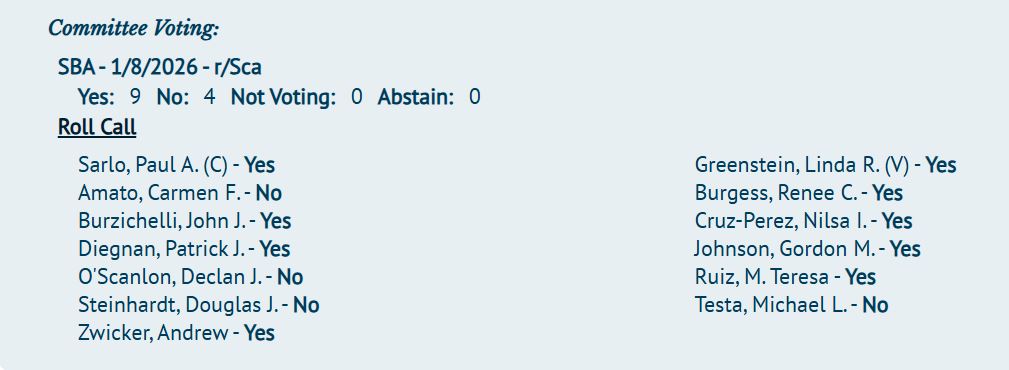
What the “Citizens Fund Act” actually does (A5980)
Another Orwellian named bill… The Citizens Fund Act (Assembly Bill 5980) creates a state-controlled trust fund that allows municipalities, counties, authorities, and other public entities to transfer or “convey” revenue-producing public assets—including water and wastewater utilities—into a new entity called the Citizens Fund 5980_S1.
Once conveyed:
- The asset is no longer fully controlled by the local government.
- The Citizens Fund Board, appointed by the Governor, becomes the fiduciary whose legal duty is to maximize long-term asset value.
- The economic value of that asset is used to boost public pension funding ratios, not to guarantee lower rates or stronger local control.
- Local governments may receive upfront value or distributions—but ownership and control are fundamentally altered.
The bill repeatedly emphasizes that the fund exists to:
- “lessen the burdens of government”
- “optimize” and “maximize” asset value
- benefit public benefit plans (pensions)
That language matters.
This is not about utility service first.
It is about financial engineering using public infrastructure.
The quiet but critical change: Water & sewer law is rewritten
Here’s where alarm bells should ring 🔔
The bill amends “WIPA” the Water Infrastructure Protection Act, (Known by some as the Water Infrastructure PRIVITAZATION Act) explicitly adding the Citizens Fund as an alternative path when a utility is declared under “emergent conditions” 5980_S1.
Under existing law:
- A town trying to sell or lease its sewer utility can be forced into a public referendum if citizens file a petition.
Under A5980:
- If officials certify “emergent conditions” (financial, operational, compliance, or capacity issues),
- The town can convey the asset to the Citizens Fund, not a private buyer, and
- That path does NOT require the same referendum safeguards.
This is a structural end-run.
Why this matters in Gloucester Township
In 2024, voters in Gloucester Township rejected the sale of the sewer utility. That vote was supposed to settle the question.
This bill reopens the door.
Here’s how, step-by-step:
- Declare “emergent conditions”
- The definition is broad: aging infrastructure, capital needs, financial stress, or “lack of managerial capacity” are all qualifying factors.
- None of these require a crisis—just an argument.
- Avoid a direct sale
- Instead of selling to a private utility (which triggers voter protections),
- The township could transfer the sewer system to the Citizens Fund.
- Local control becomes advisory
- Municipalities get an “enterprise advisory board.”
- That board has no veto power and no binding authority.
- The Fund Board makes the real decisions.
- Future privatization is still possible
- After five years, 25% or more beneficial interests can be granted to private entities.
- That’s partial privatization—without a fresh public vote.
- Ratepayers, not voters, absorb the risk
- Pension systems benefit.
- Financial optimization comes first.
- Rate increases become a “management decision,” not a political one.
In short:
Voters said no. The bill creates a pathway to say “noted, but overridden.”
Bottom line
The Citizens Fund Act transforms public utilities from community-owned infrastructure into financial instruments.
For Gloucester Township, this bill means:
- The 2024 referendum is no longer the final word.
- The sewer system could still be transferred out of direct public control.
- Residents may only find out after the decision is already made.
What can we do as residents to possibly prevent our MUA from being transferred to the CF?
I’m willing to help. Let me know what I can do.